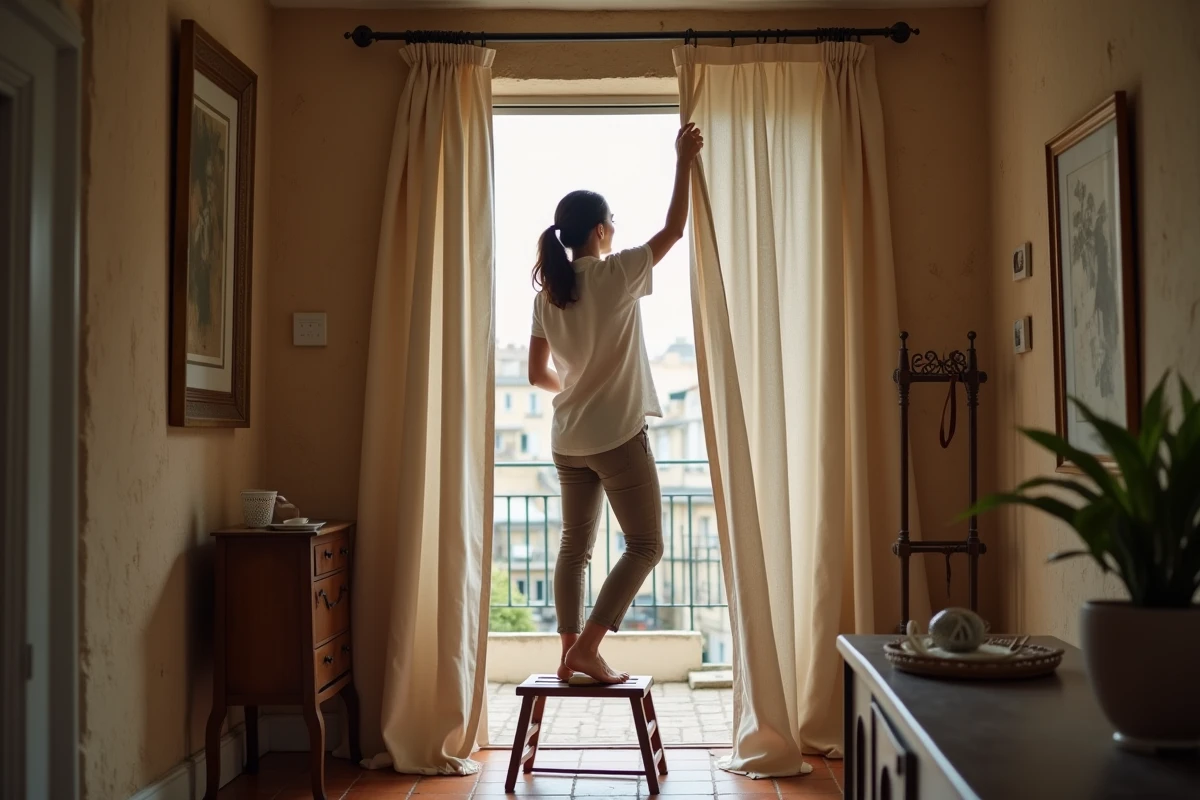
A narrow hallway with a front door that scrapes against the tiles, a door that slams with every draft, or simply an opening between two rooms that has never had a door: these are the situations where a curtain becomes a real option. Replacing a front door with a curtain is not merely a decorative whim; it is often a response to constraints of space, budget, or housing configuration.
Fire Safety and Regulations: What a Curtain Cannot Replace
Before removing a door to install a curtain, one must check a crucial point: fire regulations prohibit this replacement in certain cases. In multi-unit buildings, the entrance door must be fire-resistant and self-closing. A textile curtain, no matter how thick, fulfills none of these functions.
In public establishments (ERP), crossing devices must ensure fire resistance and smoke extraction in accordance with safety regulations. A curtain offers neither.
In practice, this solution remains suitable for single-family homes, interior rooms, or openings that do not constitute the sole evacuation access. If living in a co-ownership, one should consult the internal regulations before making any modifications. To know how to replace a front door with a curtain properly, this prior check avoids issues with the property manager or insurance.
Thermal Curtain on Front Door: The Limits of the DPE
It is often said that a thermal curtain improves the insulation of an entrance. This is true in terms of perceived comfort: the sensation of drafts decreases, and the room feels less cold. However, a curtain does not improve the DPE rating of the property.
The new generation DPE (reform effective from July 1, 2021, adjusted by the decree of March 25, 2024) only takes into account permanent structural elements: joinery, integrated insulation, ventilation systems. A removable curtain, no matter how dense, does not factor into the calculation.
For a single-family home where the front door opens directly into the living room, the curtain remains a useful addition in winter. It does not replace an insulating door if the goal is to enhance the property’s value for resale or achieve a better energy rating.
Choosing the Fabric and Fixing System for a Door Curtain
The choice of material determines both insulation and practicality in daily use. Not all fabrics are suitable for an opening that is crossed multiple times a day.
Materials Suitable for Frequent Passage
A front door curtain undergoes more handling than a window curtain. Durable, wrinkle-resistant fabrics that are easy to maintain are preferred.
- Thick velvet or blended wool provides a good barrier against the cold but requires dry cleaning. They are suitable for infrequently used doors (secondary entrance, pantry).
- Coated cotton or thermal-lined polyester can be machine washed and dry quickly. This is the most practical compromise for a main entrance.
- Transparent PVC strip curtains (like commercial curtains) let light through and can be wiped clean, but their aesthetic appeal remains limited in a residential interior.
Rod, Bar, or Track: Which Fixing to Choose
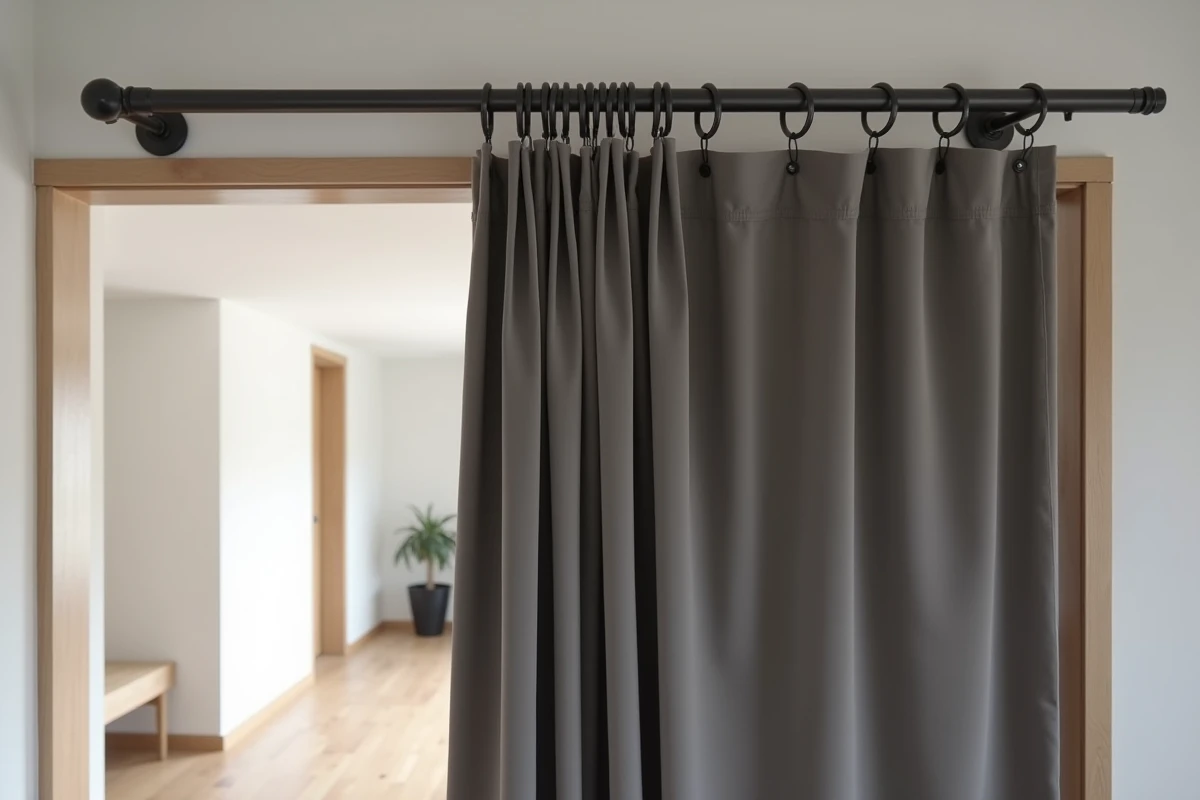
The classic curtain rod remains the simplest solution for a standard front door. It is fixed to the wall a few centimeters above the door frame, with appropriate anchors for the support (plaster, concrete, brick).
For an opening without a frame or an arched passage, a ceiling track allows the curtain to be guided across the entire width. Opinions vary on this point: some prefer the curved track for wide passages, while others find that the straight rod suffices in most cases.
A detail often overlooked: ensure the curtain is at least twenty centimeters wider than the opening on each side. Without this overhang, air passes through the edges, and the insulating effect diminishes. For height, the curtain should just touch the floor without dragging, or it will wear out quickly from passage.
Colors and Style: Adapting the Curtain to the Entrance Décor
The entrance sets the tone for the rest of the house. A poorly chosen curtain in terms of color or texture can weigh down an already narrow space.
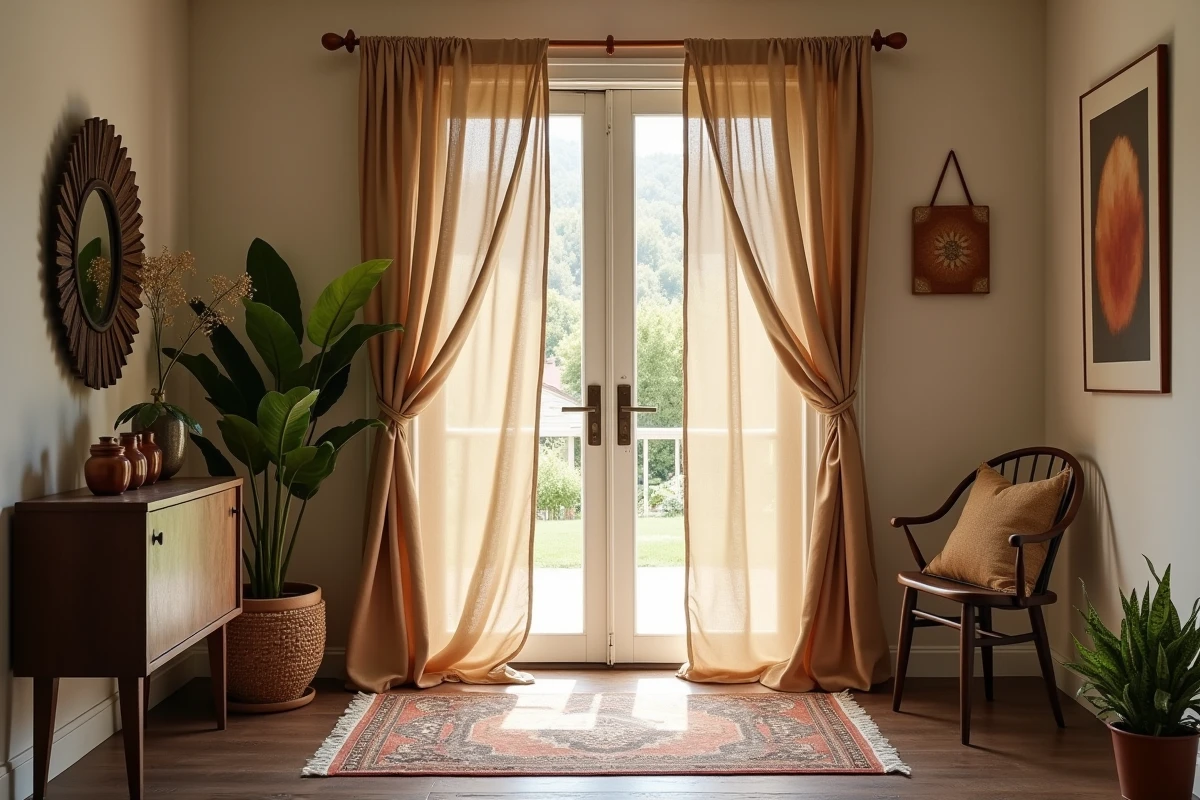
On a light wall, a curtain in a similar tone (natural linen, beige, pearl gray) visually enlarges the passage. Dark colors (burgundy, navy blue) work in spacious entries where a cozy atmosphere is desired. However, a dark curtain in a narrow hallway absorbs light and shrinks the space.
For style, avoid overly decorated curtains (busy floral patterns, fringes) that quickly date. A solid fabric with a nice texture (wrinkled linen, cotton twill) ages better and adapts if the surrounding décor changes.
Maintenance and Durability of a Door Curtain in Daily Use
An entrance curtain accumulates more dust and dirt than a window curtain, especially if the door opens directly to the outside. Plan for a machine wash every two to three months for synthetic fabrics, or seasonal dry cleaning for thick natural materials.
Eyelet fixings facilitate quick removal. Hidden leg or clip systems take longer to handle and often end up never being washed.
Replacing the curtain every three to five years remains reasonable. The fabric loses its thermal efficiency over time, fibers compress, and color fades. A curtain that has served its time insulates less than a newly chosen curtain.
The front door curtain will never replace an insulating joinery in terms of regulations and thermal performance. To gain comfort in daily life without undertaking major renovations, it is a quick solution to implement, provided the right fabric is chosen, the fixing is well done, and no safety constraints oppose it.