
The P100 is the first category of padel tournament approved by the FFT that awards a significant point allocation for ranking. The winner takes home 100 points, but the distribution among the other pairs directly depends on the number of teams entered in the draw. Understanding this mechanism allows for better tournament selection and anticipation of the actual impact of a result on one’s monthly ranking.
Sliding Calculation of FFT Ranking and Real Weight of a P100 Result
Before looking at a points distribution table, one preliminary concept conditions everything else: only the 12 best results from the last 12 months count in the FFT ranking. This ranking is recalculated every month.
A good result in a P100 does not have a fixed value over time. If a player achieves superior performances in the following months, an old P100 score may drop out of the calculation without the ranking decreasing as a result. Conversely, an inactive player sees their results gradually disappear from the sliding window.
This system has a direct consequence on strategy: it is better to regularly compete in P100 tournaments with decent results than to bet on a single tournament in the year. Consistency weighs more than an isolated standout performance. A player who checks the P100 points table before each registration can thus assess whether a given tournament has the potential to replace their weakest result among the 12 retained.

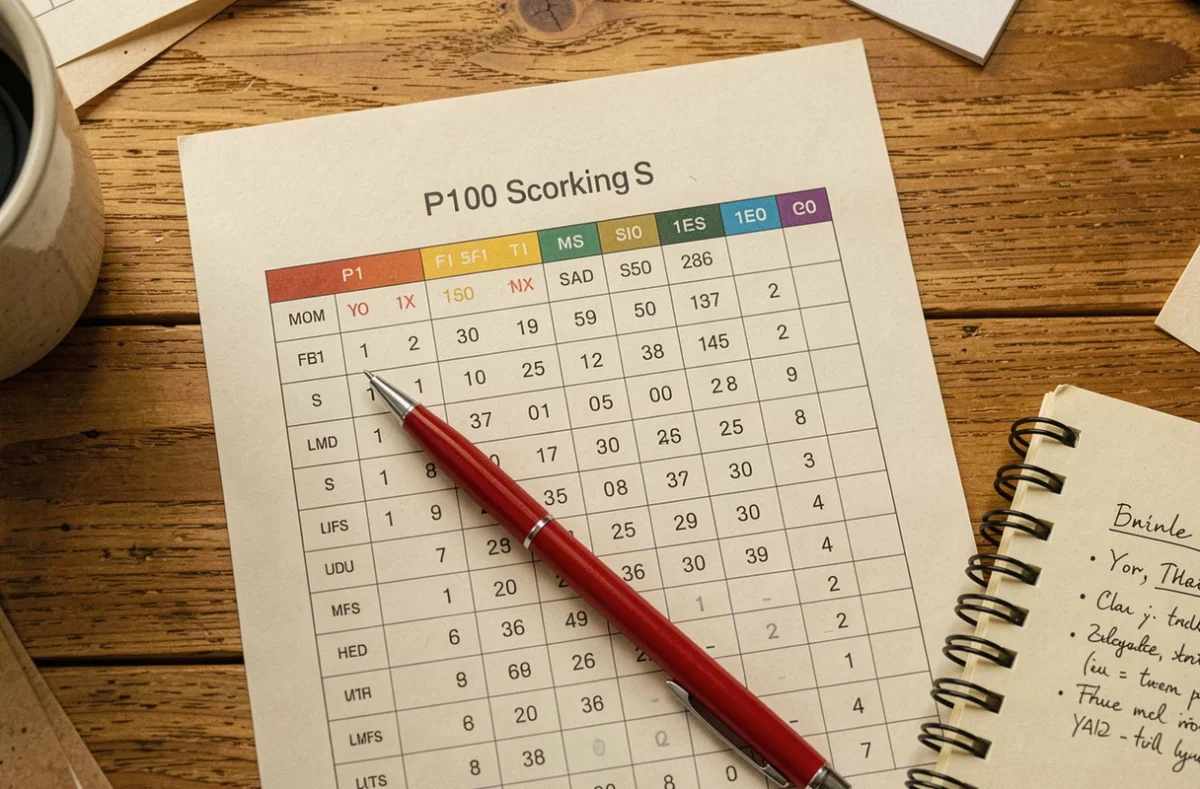
Distribution of P100 Points According to the Number of Pairs Registered
The P100 scale is not linear. The final position determines a base of points, but the number of pairs registered modifies the distribution by round. Since March 2023, the FFT has adjusted this mechanism to better reflect the density of the draw.
General Principle of the Scale
The winning pair always earns 100 points, regardless of the number of participants. This is the constant of the system. However, the points awarded to finalists, semi-finalists, and earlier rounds vary according to the size of the draw.
A tournament with few pairs will distribute fewer points in the early rounds than a tournament with a full draw. The logic is simple: beating four opponents in a draw of 32 pairs represents a more demanding path than three victories in a draw of 8.
How Draw Size Affects Intermediate Rounds
In a larger draw, points extend further down the final ranking. Pairs eliminated in the quarter-finals or round of 16 receive a more significant share than in a small draw. This detail leads some players to prefer well-filled tournaments, even if the competition is tougher, because each round victory earns more points in a large draw.
Conversely, a P100 with few entries may seem more accessible, but the points earned in the event of an early elimination will be low. Therefore, the calculation deserves to be considered before registration.
Difference Between FFT Ranking and Actual Playing Level in P100
The sports ranking and playing level do not describe the same thing. The FFT ranking reflects only the results obtained in sanctioned competition. A player who trains regularly at the club but competes in few tournaments will have a low ranking despite a correct technical level.
This distinction has a concrete impact for players hesitant to register for P100. Access criteria are based on ranking, not on an assessment of playing level. An experienced competitor returning after a break will have a rank that does not correspond to their actual capabilities on the court.
- The FFT ranking is built exclusively from results in sanctioned tournaments, recalculated every month over a 12-month window.
- The playing level depends on the consistency of training, technical mastery (volleys, bandeja, by three), and tactical experience in matches.
- Choosing an appropriate P100 requires crossing the two: checking eligibility by ranking, then estimating real chances based on current practice level.
Strategy for Selecting P100 Tournaments to Progress in Ranking
Not all P100s are equal from a ranking perspective. Three concrete parameters guide the choice.
The first is the size of the draw. As mentioned earlier, a dense draw distributes more points in the intermediate rounds. A player who regularly reaches the quarter-finals should target these tournaments.
The second is frequency. Competing in a P100 each month maintains a solid base of results in the sliding window. Spacing competitions too far apart creates gaps in the calculation and weakens the ranking, even without underperformance.
The third is the choice of partner. In padel, the pair is the competitive unit. A complementary partner (a baseline player paired with a net player, for example) increases the chances of advancing one or two additional rounds, which directly translates into points.
- Check the number of pairs registered before the registration deadline to estimate the depth of the draw.
- Plan tournaments throughout the year so that each month includes at least one result in the calculation window.
- Play several P100s with the same partner to develop habits that improve results in deciding sets.
The P100 scale rewards consistency more than isolated exploits. A player who consistently finishes in the quarter-finals in well-populated draws accumulates, over 12 months, a total of points often higher than someone who wins a single tournament and then remains inactive. The FFT ranking, through its sliding mechanism, accurately reflects this reality.