
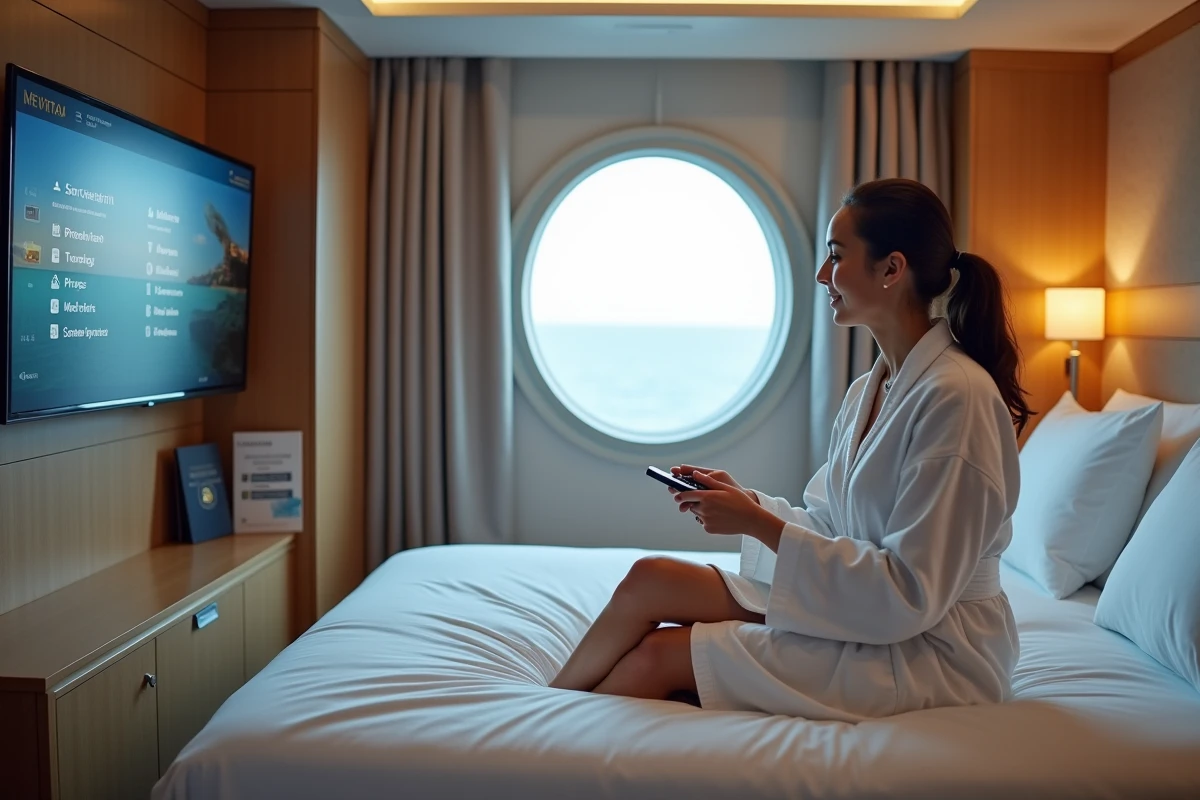
The cabin television on a cruise operates on a hybrid model: a base package of free channels, often limited to a few international programs and news bulletins, supplemented by paid content accessible via the screen or the ship’s portal. This distinction between basic access and premium options shapes the entire consideration of the onboard entertainment budget.
The question of access to TV channels on a cruise is no longer simply a yes or no answer. It depends on the type of cabin booked, the chosen company, and especially what the passenger actually expects from their screen during the journey.
Free and Paid TV Content in Cabins: Where is the Line
The cabin television systematically offers a basic package. It includes continuous news channels, a few general entertainment programs, and sometimes a selection of movies on loop. This free base is sufficient for background noise or a news broadcast before dinner.
Billing applies to specific premium content: live sports, video on demand, access to streaming platforms. These options are available in the form of temporary passes, charged daily or for the duration of the cruise. The price varies depending on the company and the ship’s standard.
The nuance to remember: cabin TV is not “paid” in the strict sense. The set works, and the basic channels are available. What costs extra are the contents that the passenger chooses to add on top.
Wi-Fi and Streaming Packages Onboard: A Game-Changing Alternative
Many passengers bypass the TV issue by relying on their own streaming subscriptions. Canal+, Netflix, or other services become accessible once a Wi-Fi package is purchased onboard. This approach seems logical, but it faces several technical constraints.
The Wi-Fi speed is often throttled for video streaming. Some companies block the most bandwidth-hungry applications or degrade the image quality to preserve the network. A high-definition movie can turn into a series of buffering episodes, making the experience frustrating.
Wi-Fi Packages and Onboard TV Packages: Two Distinct Logics
Subscribing to a premium Wi-Fi package does not guarantee access to the TV content offered by the ship. These are two separate systems. Wi-Fi is used to connect to the internet (social networks, emails, personal streaming). The onboard TV package operates through the ship’s internal system, independent of the internet connection.
A passenger who wants to watch a football match broadcast on the ship’s TV and use Netflix in the evening may potentially have to pay for both services. All-inclusive packages do not always cover pay-per-view events (matches, grand prix, concerts), even for passengers who have subscribed to the highest package.
Premium Cabins and MSC Yacht Club: When TV is Included in the Price
Higher cabin categories radically change the equation. Suite-type spaces or MSC Yacht Club increasingly include advanced entertainment services in the cabin price:
- High-speed Wi-Fi included, with sufficient bandwidth to stream personal subscriptions at no extra cost
- Expanded access to the onboard TV packages, including some premium channels that are normally charged extra
- Video on demand portal with a wider selection than in standard cabins
Upgrading to a premium cabin may be cheaper than accumulating TV passes, Wi-Fi packages, and à la carte options from an interior cabin. The calculation is worth considering before boarding, by comparing the price differential of the cabin with the cumulative cost of digital services.
Live Sports and TV Events on a Cruise: The Trap of Non-Guaranteed Content
Live sports represent the most sensitive case. A passenger wishing to follow a match or a grand prix at sea must check two distinct things: the availability of the channel broadcasting the event in the ship’s package, and the stability of the satellite reception in open water.
The broadcasting of a sporting event onboard is never guaranteed. Broadcasting rights vary depending on the geographical areas traversed by the ship. A match available in the Mediterranean may disappear during a transatlantic crossing. Subscribers to sports channels on land have already found, to their detriment, that their access no longer works once at sea.
Checks to Make Before Boarding
A few reflexes can help avoid unpleasant surprises:
- Contact the company to confirm the presence of a specific channel on the planned itinerary
- Download content in advance on streaming apps (offline mode) for times without coverage
- Plan for the fact that Wi-Fi, even if paid, may not always be sufficient to stream a live event without interruption
Downloading movies, series, or podcasts in advance remains the most reliable method to have entertainment onboard without depending on the ship’s network.

The cabin television on a cruise works, and the basic channels remain free. The real budget choice concerns premium content and Wi-Fi, two distinct expense items that can add up quickly. Comparing the price of a superior cabin with the accumulation of à la carte options from a standard cabin often allows for a clearer decision than expected.