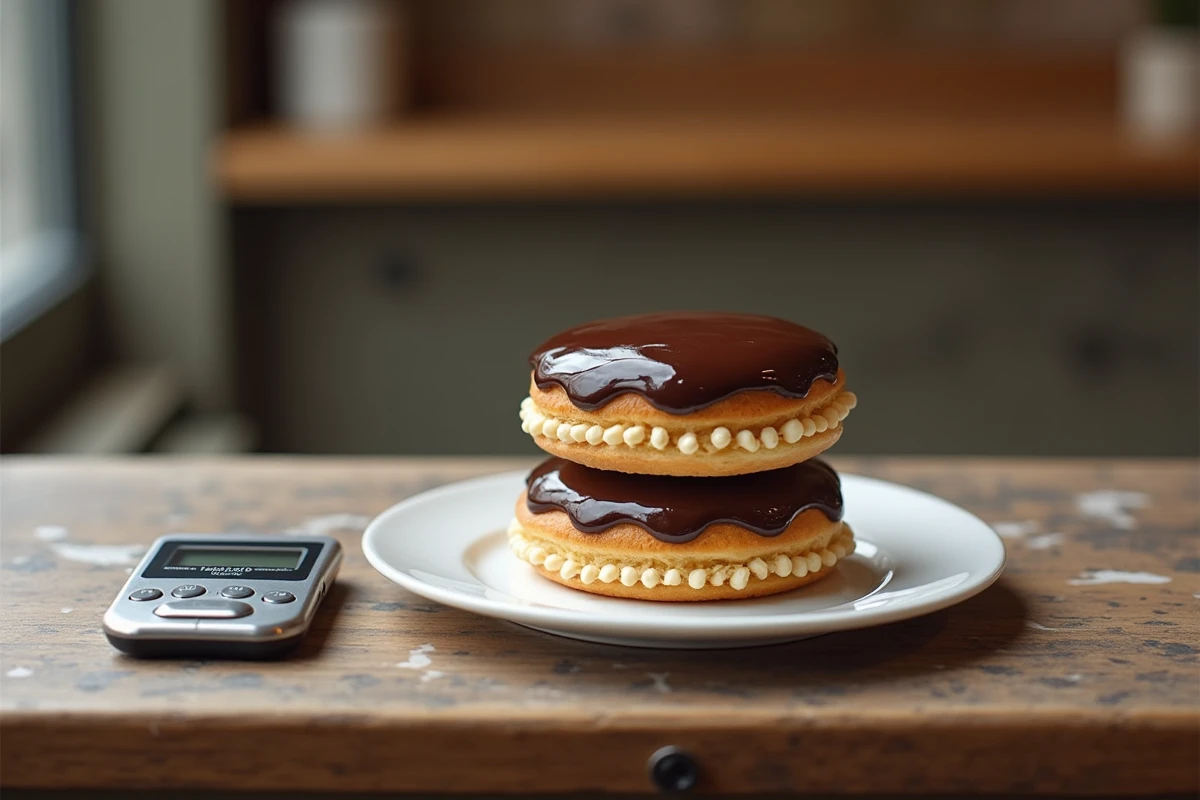
A chocolate eclair sitting on the counter of a pastry shop catches the eye with its recognizable silhouette: two cream puffs stacked, coated with brown icing, connected by a collar of cream. Its weight, however, varies much more than one might imagine. The difference between a handmade piece and its supermarket equivalent can be surprising, and it is explained by specific technical choices.
What Affects the Weight of a Chocolate Eclair in a Shop
You may have noticed that an eclair bought from an artisan seems denser than one from a self-service aisle? The difference is not random. It results from three factors that add up.
The first is the amount of pastry cream injected into each puff. An artisan pastry chef generously fills the puff, sometimes until it slightly resists finger pressure. In mass distribution, the filling is calibrated by dosing machines that deposit a fixed amount, often more modest for cost and preservation reasons.
The second factor is the thickness of the fondant icing. A thick fondant, applied by hand, adds a few grams that automated lines do not replicate in the same way. The third concerns the size of the puffs themselves: a puff baked longer in the oven swells more, but its wall thins and it weighs less at equal volume. A more compact puff, baked a little less, retains more moisture and thus more mass.
Several French artisan bakeries indicate on their online product sheets a unit weight of around 110 to 140 grams per piece for a classic individual format. This is a useful benchmark for comparison, as detailed in the weight of a chocolate eclair according to Papilles Heureuses in an article dedicated to the characteristics of this pastry.

Chocolate Eclair in Mass Distribution: A Shrinking Format
The eclairs sold in supermarkets (large and medium surfaces) often weigh less than their artisanal versions. The nutritional information published on supermarket drive sites confirms this: industrial individual formats weigh significantly less than their shop equivalents.
This phenomenon is part of a broader trend documented in France in recent years under the name of shrinkflation. The principle is simple: the price remains stable, but the weight decreases discreetly. The DGCCRF and several economic media have pointed out this practice on individual pastry products, citing filled puffs and desserts among the affected categories.
In practical terms, this means that a chocolate eclair bought in a supermarket may weigh noticeably less than it did a few years ago, without any change in packaging. For consumers who monitor the quality-price ratio, reading the net weight label remains the most reliable reflex.
Anatomy of an Eclair: Every Component Counts
Breaking down a chocolate eclair into its elements helps understand how the total weight is distributed. Here are the four main components and their relative contributions:
- The two cream puffs: the large puff (base) and the small puff (head) form the structure. Their weight depends on the cooking and the residual hydration of the dough.
- The chocolate pastry cream: this is the heaviest component proportionally. A generous filling can represent nearly half of the total weight of the piece.
- The chocolate fondant icing: a thin layer of cooked sugar that tops each puff. Its weight is modest but it contributes to the mouthfeel and the characteristic shiny appearance.
- The buttercream collar: the decorative collar between the two puffs and any potential patterns. It adds a few grams and especially butter, thus increasing caloric density.
In professional technical sheets intended for pastry chefs, the proportion of cream to puff pastry is a key parameter. Too little cream results in a light but dry eclair. Too much cream makes the piece fragile and difficult to transport.
The Role of Ingredients in the Final Texture
The quality of the butter used in the puff pastry directly influences the softness and stability of the puff after baking. High-fat butter produces a crispier puff, slightly lighter once cooled.
The chocolate incorporated into the pastry cream also plays a role: a high-cocoa couverture chocolate thickens the cream and makes it denser than simple diluted cocoa powder. This ingredient choice thus has a measurable effect on the final weight of the eclair.
Weight of the Chocolate Eclair: Practical Benchmarks for Comparison
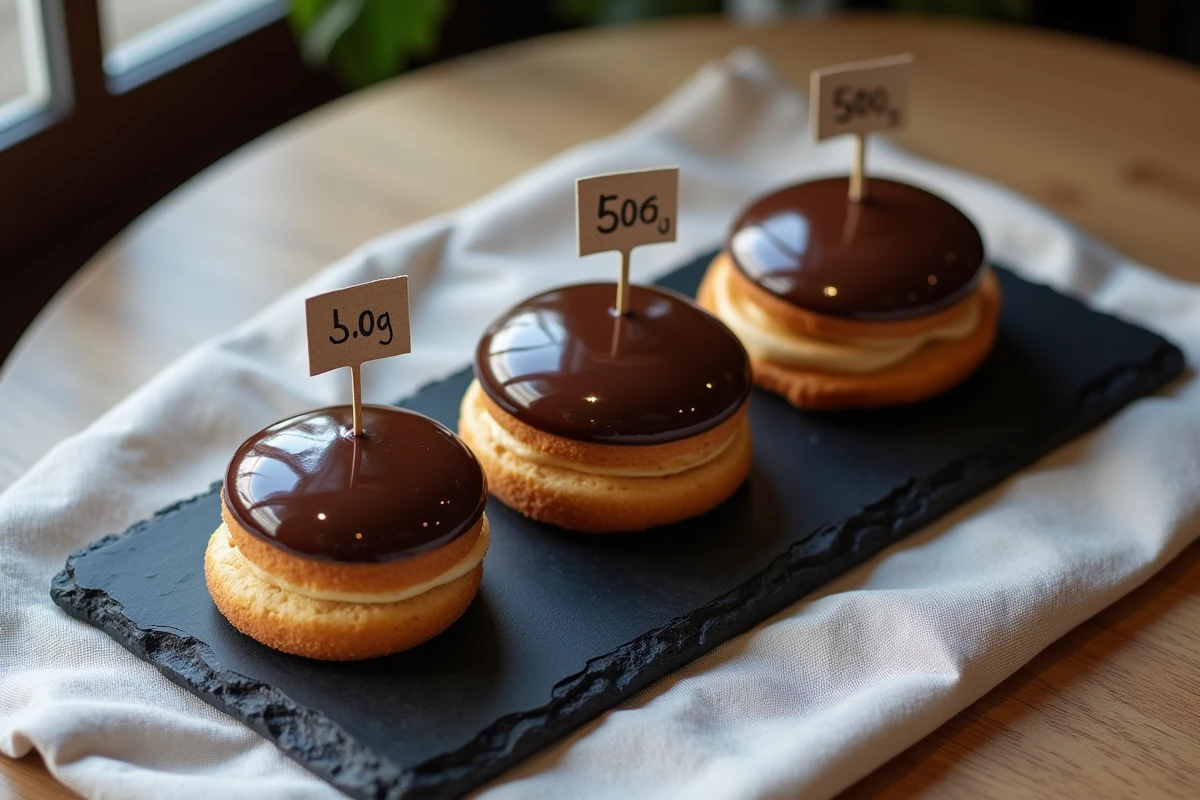
Comparing eclairs requires looking beyond appearance. Two pieces of the same height can have a significant weight difference. Here are the benchmarks to keep in mind:
- An artisanal individual format generally ranges between 110 and 140 grams.
- A mass distribution format tends to weigh less, with weights decreasing in recent years.
- A giant eclair (event format or tiered piece) can reach several hundred grams, or more depending on the number of tiers and the volume of filling.
- Weight alone says nothing about quality: a heavy eclair filled with light cream containing starches will not offer the same experience as a lighter piece based on traditional egg pastry cream and couverture chocolate.
For a professional pastry chef, the target weight is defined in advance in the recipe’s technical sheet. It determines the calibration of filling nozzles, the size of puff molds, and the amount of fondant prepared. Changing the weight of an eclair by a few grams involves adjusting the entire production chain.
The chocolate eclair remains a pastry where every gram reflects a trade-off: generosity of the filling versus structural stability of the puff, thickness of the icing versus visual clarity. Weighing your eclair before enjoying it is not obsessive; it’s simply the best way to know what you are eating.